


June 29th, 2026

Hi All,
Well, that was some week weather-wise, with the second consecutive month we have broke our all-time record temperature, first May, now June. It wasn't just the temperature but the humidity that accompanied it which made it harder to bear.

Davis have a metric to measure this called the THSW index. THSW stands for Temperature, Humidity, Sunshine (Solar Radiation) and Wind (imaginative eh?) and in basic terms it calculates a 'feels like' temperature that the body experiences.
Their official description is this ;
A calculated index that uses humidity and temperature from the Heat Index, but also includes the heating effects of sunshine and the cooling effects of wind (like Wind Chill) to calculate an apparent temperature of what it “feels” like out in the sun. The THSW Index requires a solar radiation sensor.
When we have heat with humidity, the body experiences more heat because its cooling system (sweating) is less effective. High humidity means more water vapour in the atmosphere, which in turn means the evaporation process of sweat from the body is less efficient, (because water can't evaporate as quickly into a more saturated atmosphere) so the body doesn't cool itself as well as it would with lower humidity.
Years ago there was a Army Sitcom, (which would now be seen as grossly inappropriate by the wet blanket brigade) It was called 'It ain't half hot Mum !' starring Windsor Davies and the like. It is notable for me because all of the actors had huge sweat patches on their clothing because there were stationed in a hot, humid climate. Last week in the U.K, Ireland and then the continent, we were a hot, humid climate and quite different from what we have experienced before. We need to get used to it because it won't be the last one we experience this summer, more on that shortly.
How did you cope last week and as importantly, how did your grass and facility / infrastructure cope ?
In general I think we are pretty well placed to deal with this type of heat from a turf perspective because firstly we see it coming (we had 7-10 days notice courtesy of GFS / ECMWF forecasting) and can prepare and secondly we have a number of highly-efficient tools to manage this including PGR's, surfactants, biostimulants and pigments, just for starters.
The area of stress apart from E.T on the plant comes when we look at water, its provision and supply going forward. Here we have problems and those problems are growing and growing fast.
Currently where I live in Market Harborough, successive governments have added thousands of houses to what used to be a lovely market town in Leicestershire. They have done so without investment in infrastructure, a common theme around the country as developers pocket their money and move on to the next cash cow, leaving behind a town struggling to cope with insufficient medical facilities (7 weeks to get a doctors appointment here you know), deteriorating and congested roads and no upscale on water resource. Recently villages on the outskirts of the town have run out of water during times of high demand (local events and / or high temperatures) because we have a lot more houses and no provision to upscale water supply. Our last 'new' reservoir was built in the 1970's (Rutland Water) and our new ones are still mired in planning. It seems so farcical to me to watch all that excess water go out to sea in the winter without a means of storage for times that we need it. Crazy.
Without investment and speedier decision-making in this country, we will be unable to meet the demand for water. Which of course then puts more pressure on the people who are using it, consumers, industry and agriculture. We are in that pot and at some point soon we will have to justify applying drinking water onto turf to support a local amenity. That's a tricky one and it is going to create some difficult conversations. We have to have a plan to meet this question and as that old maxim goes, 'Fail to plan, plan to fail'. I'd add another one to that, 'You can't manage what you don't measure' and this relates to how much water you're applying to manage your turf.
I am of course talking about measuring evapotranspiration (E.T - the loss of moisture from the plant and the soil) and applying irrigation as a % of that figure.

If you had to justify your water usage to a third-party, how would you do it ?
Well I guess the first part of that process is saying that I have lost 'x' amount of moisture by E.T from my site and I am applying 'y' amount of water to replace that loss as a % of the overall figure. How are you measuring E.T loss ? By a weather station, a third party projection / calculation and / or by monitoring soil moisture content ?
My point is you need a viable system in place that's robust, justifiable and based on data because the time is coming soon when we as an industry will be held to account.
The graph above shows the daily E.T loss for this June from our default location at The Oxfordshire G.C, Thame, U.K. Now this is an open site, so the E.T loss is likely to be higher than maybe your site (but not necessarily), but you can see how many days we experienced at or above the 4.0mm a day threshold that I use to signify plant stress is likely. You can also see how the E.T built in line with the heat, culminating in a calculated moisture loss of 6.5mm per day on the 26th. That's 65,000 litres of water lost by evaporation and transpiration from the soil and grass plant in just one day. That is a lot of water to replace even if you're working on a 50% replacement rate.
These stats got me thinking about past heatwaves and how we compare with previous June heatwaves ?

What we can see from the graph above is that last week's heatwave came with a higher E.T peak than we have experienced in the recent heatwaves of 2018, 2022 and 2025, though 2022 was very similar. In terms of total E.T for the month, this is how they shape up to and including the 28th of June for 2026 vs. full month data for 2018, 2022 and 2025 ;
Month Total moisture Highest daily E.T No. of days No. of days
loss by E.T during month >=4.0mm E.T >=5.0mm E.T
2018 101.4mm 5.6mm 12 3
2022 109.3mm 6.5mm 15 8
2025 112.6mm 5.9mm 17 6
2026 108.6mm 6.5mm 14 7
June 2026 was saved by a pretty cool and wet first half of the month, but even then the higher E.T for the rest of the month to date has put it on terms with past heatwave's and with two more days to run it'll no doubt eclipse them.

Another area where the recent heatwave exceeded past events was in the daily mean temperature as you can see from the graph above. Those hot, muggy nights were something else peaking at a mean daily temperature of 27.4°C on the 27th of June, wow ! That gives us and the grass plant very little opportunity to cool down, except when irrigating or syringing. It is a fact that we haven't seen anything like those temperatures before in terms of recorded weather data.
Listening to the radio this morning there are murmurings of the heat returning later this week so what's the craic ?
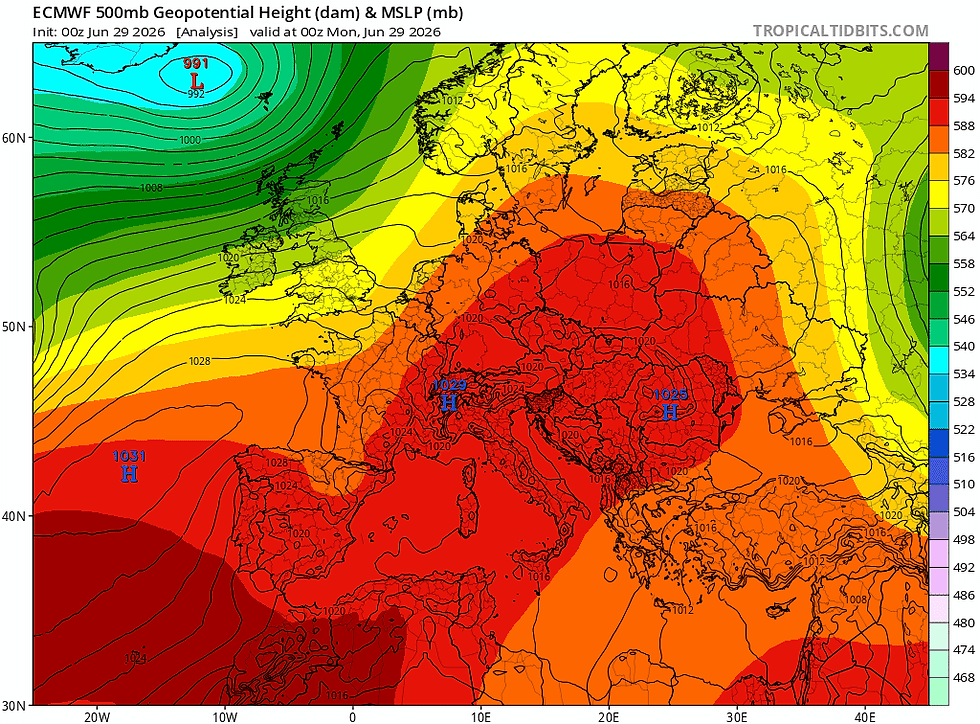

For this week we can see that hot air plume from Africa has moved eastwards into central Europe now giving most of us a breath of nice cool air, especially at night. As we move from Monday into Tuesday, an Atlantic low pressure will push rain and cooler winds into Ireland and the west of the U.K. Unfortunately this will not make progress further south and east so most of the rainfall will be in the west, north west and north. As we move into Wednesday, a warm air, high pressure peak begins to build again to the west of Ireland, so we will see that heat return, first to the west and then across the south of the U.K later into the week / weekend. Scotland and Northern Ireland though may see a distinct lack of heat and more in the way of rain at the weekend.
Now, before you run to the hills at the prospect of a repeat of last week, there is currently a subtle difference between the two events.
Firstly, the position of the hot air plume is to the west of the U.K this time and that's important because the leading edge of that high pressure will pull down cooler, north westerly winds. Crucially this should avoid the heat excesses of last week. This morning the projection for the weekend was 30°C, the latest projection is now 27°C, so let's hope it's a tad more tolerable. Night temperatures are also in the mid to high teens, again more bearable for us all. Let's hope it doesn't change from this projection because it could easily do so as we approach the weekend.
What I can't see currently is any appreciable rain for The Midlands or East Anglia / South of England. So that demand for water will continue to be high for the foreseeable I think.
Now for Denmark, I can see some respite from the recent record heat, with Odense breaking the Danish record last week at 36.6°C. That north westerly airstream will assert itself this week to bring welcome cooler temperatures and rain I think on Thursday and through the coming weekend. Lucky you :)
OK, that is me for another week, before I go I'd just like to wish all those on the grounds staff at Wimbledon, a super event. I am so glad it didn't start last week because that would certainly have made life tricky for the first week of play. Baseline temperatures for sure would have been in the low to mid-40's on Centre Court and No.1 and that isn't great for Lolium perenne receiving heavy wear day in and day out.
Don't forget to keep putting water out for the birds, insects and of course Hedgehogs. Currently my plant tray is heaving with baby Blue and Great Tits. I have never seen so many young fledglings. They are costing me a fortune in Suet sprinkles, suet blocks and sunflower seeds but the pay back in watching their antics is priceless.
All the best.
Mark Hunt


Comments