


March 16th, 2026

Hi All,
First up, my apologies for not sending out a Monday morning blog for awhile, I have had a lot of talks on my plate this spring (entirely of my own choice I know) and I have needed all of my time to keep up with putting them together. It is worth saying that at some point this year, this chapter of my work will come to an end as I embrace something a bit more like the retirement I had envisaged, That said, no need for a blog when the sun has been shining (occasionally) and temperatures have been high enough (occasionally) for a nice bit of growth in the first month of meteorological spring. What's not to like ?

Last week, as I was driving up to Stafford to give a talk to the Staffordshire Association of Ground Managers (STAG for short) and I noticed that lovely bio-indicator -Cochlearia danica (Danish Sea Scurvy) coming into flower alongside the road. This plant is a great example of an adaptive species, it's a halophyte (salt-tolerant) and that's why you see it growing on the salt splash line at the sides of the road. Once it dies back, the seeds are blown along the roads by traffic and so it is spread very efficiently. It tends to come into flower pretty much on the money of 100 cumulative GDD (@ 6°C base) from January 1st every year and so acts as a good indicator for Poa annua var. annua, the clumpy annual Poa biotype that appears seeding on approaches, surrounds and other coarse areas of turf.
Elsewhere the pleasant temperatures have welcomed the first Chiffchaffs to our hedgerows and it won't be long before the first Swallows and House Martins join me by the waters edge as I fly fish. Certainly there's plenty of insects about for them to snaffle.
Now one Swallow does not a summer make (great link eh?) and one could be forgiven for thinking that this run of sunshine and showers weather means that Spring is well and truly here weather-wise. For sure it has given us a head start to growth in 2026 vs. last year (see GDD Comp below) and a most welcome one after the dullest, PAR-deficient winter for a long time.
The chance of this period of growth lasting through the spring though is about as likely as a coherent statement with a semblance of logic from that big, fat, orange man across the water. Go figure.

This week is a prime example of what we can expect, some mild, even warm, south westerly winds ushering in for the first half before the wind turns 180° and we pick up an easterly airflow. The reason for this is a big meander in the jet stream, possibly as a result of a recent Sudden Stratospheric Warming event in early March. Above is the ECMWF projection from the North Atlantic and you can see when we get to mid-week, this week, that the normal run of west-east weather systems halts and in fact the low pressure system visible on the chart above begins to move westwards. This pulls in a run of easterly winds which means cooler and possibly duller as well as the wind picks up cloud cover from The North Sea. So it's very much a week of two halves, mild and windy up until the peak of temperatures on Wednesday and then dropping back from the mid-teens to 9-10°C. With high pressure holding fort, it also means it'll be a pretty dry week as well with some rain crossing the north west of Ireland into the west of Scotland on Tuesday but thereafter, pretty dry it seems.
Now cold, dry easterlies aren't my idea of fun when it comes to growing grass, yes maybe some of you need some time for areas to drain down and dry up, but easterlies are bad news for turf and for fly fishing for that matter !


So, as high pressure asserts itself later in the week and spins those winds easterly (or more northerly for Denmark), temperatures drop and we pick up more cloud cover.
So, how long will this last ?
Well, the ECMWF and GFS projections differ here, with the former suggesting we revert to a stronger jet stream mid-week, next week, so that means milder, windier and wetter again. The latter however suggests we may pick up a wintry spell of much colder weather for the last weekend of March (28th, 29th). This is how models differ and let's see who is most accurate.

Agronomic Notes
Temperature vs. Light
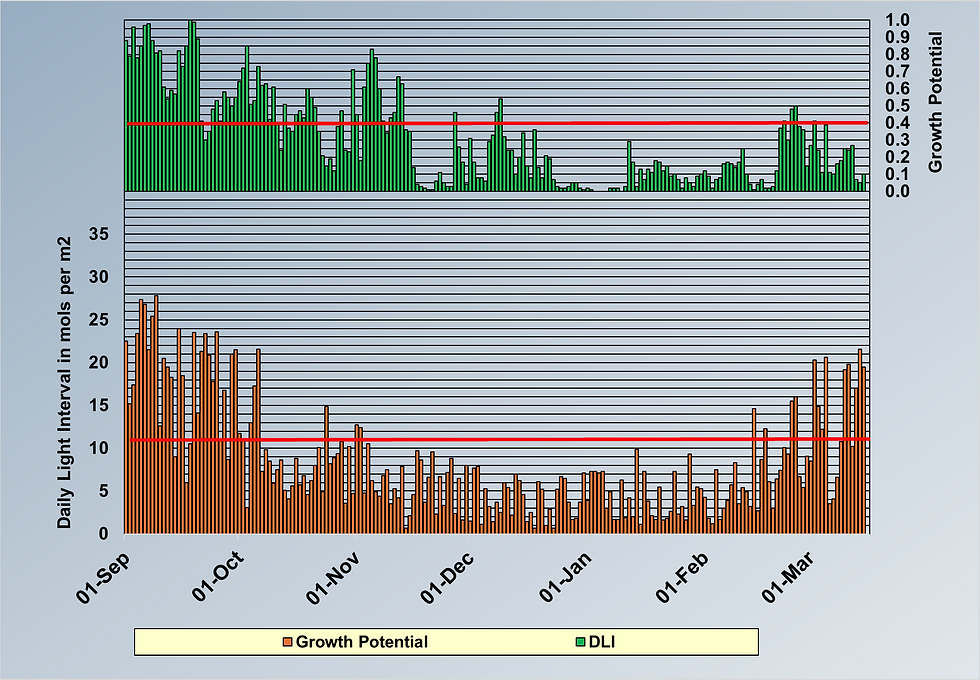
So, this past few months I have been talking about the conundrum that I think our modern-day climate serves us up for the autumn / winter and early spring.
That conundrum is caused by two sort of competing factors.
The first is warmer spells of weather occurring later into the year and stimulating grass growth. On the chart above you can clearly see these when you follow the Growth Potential top graph. The second is the spell of rainfall we have endured which brings with it thick cloud cover, which in turns means less sunlight / solar radiation reaches the earth's surface. Less solar radiation means less PAR (plant active radiation) which to my mind then means a plant that grows in an elongated (etiolated if you want the fancy declaration) fashion towards the light. Elongation / etiolation equals thinner cells walls and a grass plant more wear and disease susceptible.
You can see that we had very few days of sunshine / PAR last winter, with that red line showing the quoted minimum sufficiency level for Lolium perenne, Browntop Bent is probably a little higher, maybe in the range 15-20 from a DLI perspective. You can also see that following the winter we didn't receive sufficient DLI levels until the beginning of March and that this also coincided with a nice peak in Growth Potential. The culmination of the two gave us not just an early growth hike, but also a balanced growth hike as the grass plant finally had sufficient light to photosynthesise. My feedback was suddenly we had a healthy looking grass plant again. As expected, both parameters have dropped back a little since but I expect them to peak again this week for a short period as temperatures rise.

2026 vs. 2025 GDD Comparison
Last week, when I was talking at the STAG event, I put up a comparison of cumulative GDD from 2025 vs. 2026. The flat GDD portions of the graph are when there is little or no growth. The steeper portions are when we are seeing GDD being added on a daily basis, representative of growth. Interestingly at this location, growth started at pretty much the same point in both years, between the 19th - 21st of February. In 2025, growth flat-lined soon after, but in 2026, the growth has carried on nicely with a couple of short no-growth blips. At this location, we are tracking 14 days ahead of last year in terms of reaching a certain GDD total (in this case, 96 cumulative GDD).
So far, so good then for Spring 2026, a short peak coming up this week before growth drops away a little as those easterlies kick in. Thereafter, well that depends on which long-term forecast is accurate, let's hope the GFS one is not correct !
OK, that's me for this week, off to the Blonde Assassin for my now quarterly shoulder work, ho hum and all the best.
Mark Hunt


Comments